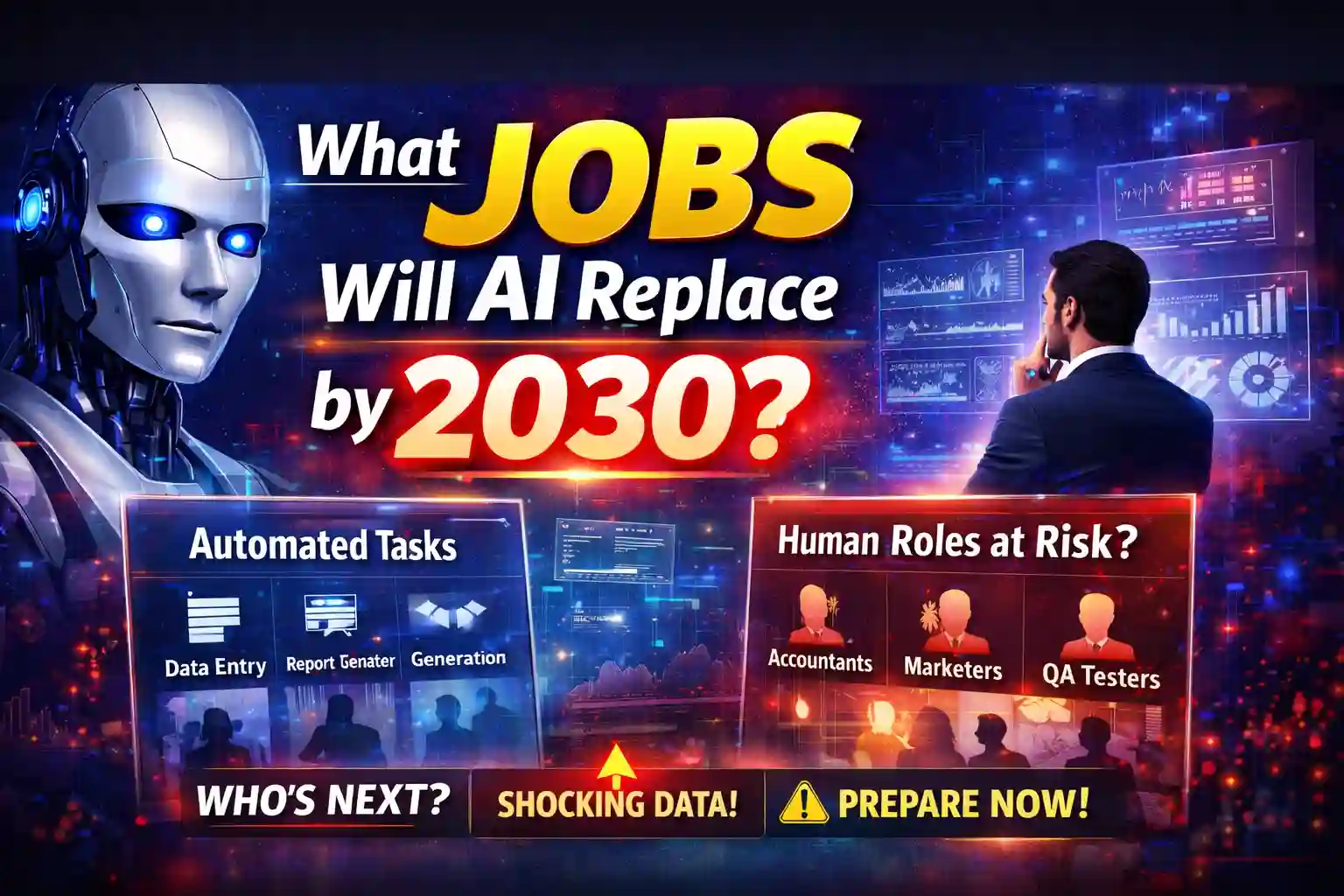
What jobs will AI replace by 2030?
For professionals, this is not a headline. It is a strategic question about relevance.
The real disruption is quiet.
No mass firings.
No dramatic announcements.
Instead:
- Hiring freezes in certain roles
- Smaller teams producing the same output
- “Efficiency programs”
- “Process optimization” initiatives
AI does not replace people directly.
It replaces work density.
When one person, aided by AI, delivers the output of three, organizations do not “celebrate efficiency.”
They redesign structure.
This is why what jobs will AI replace by 2030 must be reframed:
Which parts of my role become unnecessary when intelligence becomes cheap?
[Image: Executive desk with floating AI dashboards, some tasks fading away]
Jobs vs Tasks: The Real Unit of Disruption
Technology rarely deletes an entire role overnight.
It deletes fragments of work:
- Drafting
- Summarizing
- Checking
- Sorting
- Scheduling
- First-pass analysis
At first, this feels like help.
Then something subtle happens.
Managers begin to ask:
- “Do we still need five people for this?”
- “Can one person now manage two regions?”
- “Why are we hiring juniors for this task?”
A role becomes lighter.
Then thinner.
Then optional.
This is why the correct lens is not “job loss.”
It is task density collapse.
If 40–60% of your weekly work is automatable, your role shape changes—even if your title remains.
What jobs will AI replace by 2030?
Why 2030 Is the Inflection Point
Four forces converge between now and 2030:
- AI becomes native
- In email
- In spreadsheets
- In CRMs
- In IDEs
- In design tools
- Cost of intelligence collapses
- What once required teams now costs cents
- Output expectations double
- Reports in minutes
- Prototypes in days
- Insights on demand
- Hiring shifts from headcount to capability
- Fewer juniors
- More hybrid roles
- Smaller teams
The market stops paying for effort.
It pays for outcome velocity.

The Three Frameworks Every Professional Needs
1. The Task Exposure Model
Every role can be decomposed into three layers:
- Mechanical Layer
- Data movement
- Formatting
- Reconciliation
- Scheduling
- Analytical Layer
- Pattern recognition
- Comparison
- Rule-based decisions
- Human Layer
- Judgment
- Trust
- Negotiation
- Ethics
- Accountability
AI attacks Layer 1 immediately.
It steadily erodes Layer 2.
Layer 3 remains human-dominant.
Your risk is proportional to how much of your work lives in Layers 1 and 2.
What jobs will AI replace by 2030?
2. The Role Erosion Curve
Roles rarely “end.”
They thin.
Stage 1 – Assisted
AI speeds you up.
Stage 2 – Compressed
Your output becomes baseline.
Stage 3 – Optional
Fewer people are needed.
Stage 4 – Reframed
Only strategic versions of the role survive.
Most mid-career professionals are currently between Stage 1 and Stage 2.
3. Skill Half-Life
A skill’s half-life is the time before it loses half its market value.
In the 1990s:
- A technical skill lasted 10–15 years
Today:
- Many skills decay in 3–5 years
AI accelerates this decay.
If your core skill is:
- Tool-specific
- Process-bound
- Non-transferable
You are exposed.
What jobs will AI replace by 2030?
Functions Under Pressure
These are not “dead careers.”
They are functions undergoing structural compression.
IT & Engineering
At Risk Tasks:
- Boilerplate code
- Basic test case creation
- Routine debugging
- Documentation
- Migration scripts
AI already:
- Writes functional code
- Generates test suites
- Explains errors
- Refactors modules
Before AI:
- Junior → mid → senior via repetition
After AI:
- Fewer juniors
- Faster leap to architectural thinking
- More emphasis on:
- System design
- Security
- Reliability
- Business alignment
The “code-only” engineer thins.
The system thinker rises.
Operations & Administration
At Risk Tasks:
- Scheduling
- Meeting notes
- Report formatting
- Workflow routing
- Data consolidation
AI now:
- Manages calendars
- Drafts emails
- Summarizes meetings
- Prepares dashboards
Before AI:
- Ops teams scale with volume
After AI:
- Ops teams scale with complexity
- Fewer people
- Higher decision authority
The role shifts from executor to orchestrator.
Marketing & Content
At Risk Tasks:
- Generic copy
- SEO filler content
- Campaign variations
- Caption writing
AI excels at:
- Drafting
- Variation generation
- A/B copy
- Basic research
Before AI:
- Volume = value
After AI:
- Insight = value
- Brand coherence = power
- Strategy = premium
The market no longer pays for writing.
It pays for thinking expressed clearly.
What jobs will AI replace by 2030?
[Image: “Before vs After AI” role map for IT, Ops, Marketing]
The Functions That Will Reshape, and How to Stay Indispensable
BFSI (Banking, Finance, Insurance)
AI is already embedded in:
- Credit scoring
- Fraud detection
- Risk profiling
- Robo-advisory
- Compliance monitoring
Tasks at Risk
- Loan application screening
- Manual KYC checks
- First-level underwriting
- Standard portfolio recommendations
- Report generation
These are pattern-heavy and rule-bound.
AI thrives here.
What Survives
- High-stakes decision-making
- Regulatory interpretation
- Relationship management
- Ethical judgment
- Crisis handling
Before AI:
Banks scaled by hiring more analysts.
After AI:
Banks scale by:
- Automating routine decisions
- Elevating humans to:
- Exception handling
- Trust-building
- Strategic advisory
The “form processor” disappears.
The risk strategist remains.
What jobs will AI replace by 2030?

Human Resources (HR)
HR is undergoing one of the fastest transformations.
AI already handles:
- Resume screening
- Candidate ranking
- Interview scheduling
- Skill matching
- Engagement surveys
Tasks at Risk
- CV shortlisting
- Interview coordination
- Basic onboarding
- Policy FAQs
- Attrition analytics
What Survives
- Culture design
- Leadership coaching
- Conflict resolution
- Org design
- Talent strategy
Before AI:
HR focused on administration.
After AI:
HR becomes:
- A people strategy function
- A culture architect
- A leadership enabler
The “resume sorter” vanishes.
The organizational designer becomes critical.
Finance
Finance teams are seeing rapid automation.
AI handles:
- Reconciliation
- Variance detection
- Forecasting
- Compliance checks
- Scenario modeling
Tasks at Risk
- Journal entries
- Expense classification
- Report formatting
- Budget tracking
- Standard forecasting
What Survives
- Interpretation
- Business partnering
- Risk framing
- Capital strategy
- Ethical oversight
Before AI:
Finance was backward-looking.
After AI:
Finance becomes:
- Predictive
- Strategic
- Embedded in decisions
The “number compiler” fades.
The business advisor rises.
Sales & Business Development
Sales is being restructured by AI in two ways:
- Automation of outreach
- Intelligence amplification
AI already:
- Scores leads
- Writes emails
- Schedules follow-ups
- Analyzes call sentiment
- Predicts churn
Tasks at Risk
- Cold outreach
- Lead qualification
- Basic demos
- CRM updates
What Survives
- High-value negotiation
- Relationship building
- Complex solution design
- Trust creation
- Deal strategy
Before AI:
Sales success = volume + persistence.
After AI:
Sales success =
- Insight
- Timing
- Personalization
- Strategic thinking
The “dialer” disappears.
The solution architect dominates.
What jobs will AI replace by 2030?
[Image: Industry grid showing “Automated Tasks” vs “Human Advantage” across BFSI, HR, Finance, Sales]
Roles That Will Grow, Not Shrink
These roles exist because AI creates complexity as fast as it removes work.
- Product Managers for AI systems
- Decision Scientists
- AI Operations Managers
- UX & Trust Designers
- Cybersecurity Architects
- Compliance & Risk Leaders
- L&D Experience Designers
- Sales Engineers
- Domain Translators (business ↔ AI)
These roles:
- Frame problems
- Direct machines
- Interpret outcomes
- Own consequences
They sit at the boundary between:
What machines can compute
and what humans must decide
The Executive Career Audit (15 Minutes)
Score each statement from 0 (No) to 2 (Yes).
Task Exposure (0–10)
- My work is repetitive
- Rules decide most outcomes
- My output follows templates
- My work is easy to verify
- A junior could do this with tools
Leverage Potential (0–10)
- I use AI weekly
- I automate part of my workflow
- I combine two domains
- I own outcomes, not tasks
- I learn continuously
Interpretation
- 0–6: High erosion risk
- 7–13: Transition zone
- 14–20: Future-aligned
The 90-Day Professional Pivot Plan
Days 1–15 – Map
- List your top 25 weekly tasks
- Tag:
- Mechanical
- Analytical
- Human
- Learn one AI tool deeply
Days 16–45 – Leverage
- Automate one core workflow
- Save at least 20% time
- Document:
- Before vs after
- Impact
- Insights
Days 46–90 – Reposition
- Add “AI-assisted workflow” to CV
- Create a mini case study
- Lead one automation initiative
- Teach one colleague
Your goal:
Become the person who translates AI into results.
Final Strategic Takeaway
AI will not replace professionals.
It will replace:
- Static roles
- Rigid skillsets
- Task-bound identities
The winners of 2030 are not:
- The youngest
- The most technical
- The most credentialed
They are the ones who:
- Redesign their roles
- Own outcomes
- Learn continuously
- Combine human judgment with machine speed
So the real question is not:
“What jobs will AI replace by 2030?”
It is:
“Which version of me will still be indispensable in 2030?”
That version is not given.
It is built.
External Links (DoFollow Sources)
- [External Link: “According to McKinsey’s research on automation by 2030” – https://www.mckinsey.com/mgi/our-research/a-new-future-of-work-the-race-to-deploy-ai-and-raise-skills-in-europe-and-beyond] (McKinsey & Company)
- [External Link: “World Economic Forum press release: Future of Jobs Report 2025 (2025–2030 outlook)” – https://www.weforum.org/press/2025/01/future-of-jobs-report-2025-78-million-new-job-opportunities-by-2030-but-urgent-upskilling-needed-to-prepare-workforces/] (World Economic Forum)
- [External Link: “Goldman Sachs: Generative AI could raise global GDP and expose jobs to automation” – https://www.goldmansachs.com/insights/articles/generative-ai-could-raise-global-gdp-by-7-percent] (Goldman Sachs)
See more >>> Zara AI breakthrough