
AI Regulation News: Latest Global Policies, Trends & Business Impact
Introduction-AI Regulation News
AI is no longer just a tech trend — it’s a regulated technology shaping industries, economies, and national strategies. Governments are scrambling to balance innovation with safety, ethics, and public trust.
This article compiles the latest AI regulation news and explains:
- Who is regulating AI and how
- What new laws or actions were introduced
- How these regulations impact businesses and tech leaders
- What professionals must watch in 2026+
Let’s dive in. AI Regulation News.
What’s Happening Now: AI Enforcement Moves Into High Gear- AI Regulation News
Global Shift from Loose Standards to Rules
In 2026, the regulatory landscape is no longer informal or optional — enforcement is beginning to take shape. Countries are moving from guidelines and codes of practice to binding legal frameworks for AI governance. (FinancialContent)
This marks a transition from the early “AI Wild West” era to a more structured world where governments expect demand accountability, safety, and transparency.
Major AI Regulation Headlines (Recent)
Here are the most influential and recent developments across the globe:
1. Spain Moves to Curb AI Deepfakes — Reinforcing Consent Laws
Spain’s cabinet has approved legislation targeting AI-generated deepfakes, especially those violating consent and personal rights. The draft law restricts commercial use of AI imagery without explicit permission and criminalizes non-consensual use of images. (Reuters)
Why it matters: Countries are tightening image-related regulations to protect privacy, dignity, and individual rights in the face of rising deepfake misuse.
2. UK to Criminalize Non-Consensual AI Imagery
In the UK, non-consensual intimate AI-generated images (including deepfakes) will become prosecutable as priority offences under new online safety laws. This includes heavy fines for platforms that fail to enforce protective measures. (Financial Times)
Impact: Platforms hosting AI tools may face multi-million-dollar penalties if they don’t comply with safety requirements.
3. Malaysia & Indonesia Block AI Chat Tools
Malaysia and Indonesia have blocked access to certain AI chat services — notably Elon Musk’s “Grok” — due to concerns over generating harmful or explicit content without sufficient safeguards. (AP News)
Significance: Developing economies are also imposing AI limits when safety or public order is threatened.
4. Business & Government Control Platforms Emerge
IBM announced a new platform — “IBM Sovereign Core” — to give governments and enterprises full control over AI data, identity, and compliance tools. (TechRadar)
Why this matters: Regulation is driving demand for tech solutions that help corporations and regulators manage AI risk, security, and audit responsibilities.
5. India Advances AI Innovation Hubs
India’s Telangana announced a major AI Innovation Hub at the 2026 Davos forum. While not a regulation per se, this strategic move signals how AI governance and economic leadership are linked. (The Times of India)
Context: India is focused on safe, innovative, globally competitive AI growth, not just regulation.
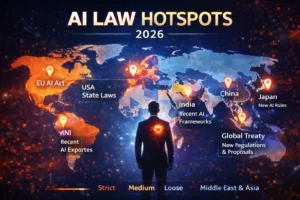
The Big Regulatory Frameworks Influencing the World-AI Regulation News
Below are the most impactful policy frameworks shaping AI governance globally.
🧠 European Union: The AI Act
The EU’s AI Act is the most comprehensive regulatory framework for AI in the world.
- Entered into force August 1, 2024
- Phased implementation until 2027
- Risk-based categories for AI systems
- Controls for high-risk applications (e.g., healthcare, finance, recruitment)
- Obligations for transparency, documentation, and risk assessment (Digital Strategy)
The EU AI Act aims to protect citizens while setting international norms. Even non-EU companies must comply if they serve EU users — making this a global regulatory benchmark.
🧵 U.S. Regulatory Landscape — Fragmented but Active
Unlike the EU, the U.S. does not yet have a single federal AI law. Instead:
- AI regulation is emerging through a mix of:
- State laws (AI transparency, safety, anti-deepfake rules)
- Executive policy directions
- Sector-specific guidelines for regulated industries
- Some states (e.g., California) have passed targeted AI laws focusing on transparency and risk reporting for large models. (Wikipedia)
This system creates a patchwork of compliance requirements for companies operating across multiple states.
🏛️ Global Treaty: Framework Convention on AI
More than 50 states have endorsed a landmark treaty that ties AI regulation to human rights, democracy, and the rule of law. (Wikipedia)
This convention sets guiding principles — transparency, accountability, non-discrimination — for AI governance and may influence future international standards.
Why AI Regulation Is Accelerating in 2026
Several factors are driving the surge in AI regulation:
📈 AI Outpaces Laws
AI development is moving faster than traditional laws can keep up. Governments are struggling to adapt outdated statutory frameworks to modern AI technologies, especially autonomous systems. (The Economic Times)
🌍 More Countries Getting Involved
Over 70 countries have proposed AI rules or policy frameworks, with new bills often focusing on:
- AI safety
- Bias and fairness
- Accountability
- Transparency
- Deepfake/consent protection
- AI consumer protection (Mind Foundry)
This mosaic of regulations means businesses must monitor local requirements as they expand internationally.
🤝 Diverging Global Approaches
Regulatory approaches vary:
- EU: Precautionary, risk-based
- US: Innovation-friendly with state-level rules
- Asia (China/Japan/South Korea): Dual focus on innovation + control
- Developing regions: Targeted restrictions (deepfakes, harmful content) (Mind Foundry)
These differences explain why global compliance is becoming both more important — and more complex.
Sector-Specific Regulation Trends
🧬 Healthcare & Pharmaceuticals
The FDA and European Medicines Agency (EMA) have jointly issued principles for safe AI use in drug development, prioritizing both innovation and patient safety. (ETPharma.com)
This signals deeper cross-border regulatory coordination in critical sectors.
🎥 Media & Deepfakes
Countries are drafting laws that criminalize non-consensual AI imagery to curb harms — a trend seen in Spain, the UK, and elsewhere. (Reuters)
Media companies and platforms that host user-generated AI content must prepare for tighter consent and liability standards.

What Businesses Must Do (Practical Takeaways)
AI regulation is no longer theoretical — it will affect real operations, products, and legal risk. Here’s how to stay ahead:
1. Map Regulatory Exposure
Identify where your AI systems operate and which rules apply — from EU AI Act to state-level laws in the U.S. and other national laws.
2. Build Compliance Frameworks
Mandatory compliance areas include:
- Algorithmic risk assessment
- Impact documentation
- Transparency reports
- Data privacy alignment
- Bias mitigation programs
3. Operationalize Safety & Ethics
Embedding governance into product development and deployment is now a competitive advantage, not just a legal requirement.
4. Monitor Global Policy
Regulatory timelines are shifting fast — tools like global regulatory trackers are essential for compliance teams.
Final Thought- AI Regulation News
AI regulation is not a future problem — it is happening now, on multiple fronts, and impacting business strategies globally.
Staying informed isn’t optional.
It’s a business imperative.
By tracking AI regulation news and building governance frameworks early, organizations can:
✔ Minimize legal risk
✔ Enhance user trust
✔ Improve AI safety
✔ Unlock strategic opportunities
The new era of AI is regulated intelligence — and informed leaders will shape how it works for humanity.
AI Regulation News
See more >>> Zara AI breakthrough