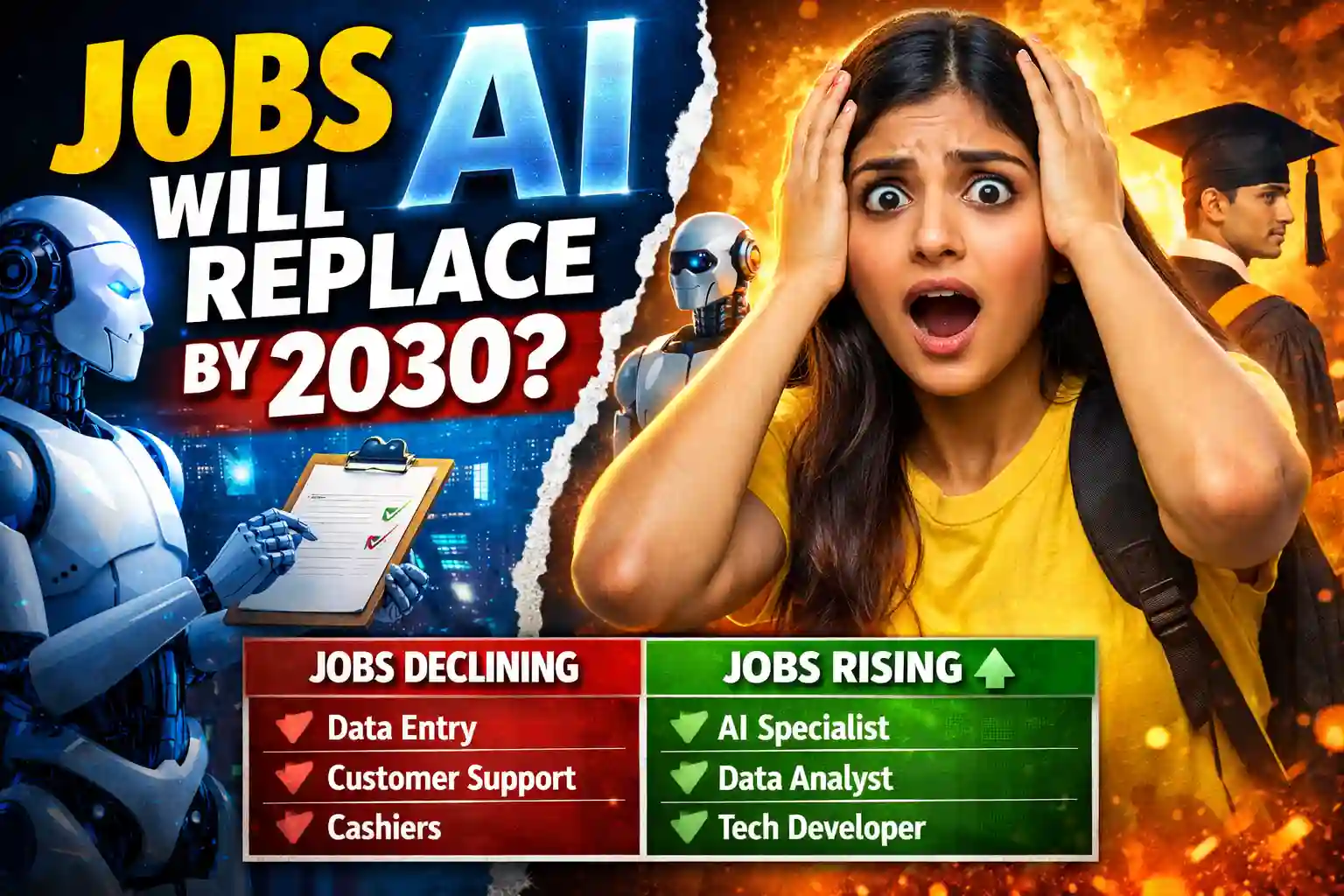
What jobs will AI replace by 2030? If you’re a student, this is not a “future” question. It’s a “choose your path” question.
A friend of mine (let’s call her Aisha) was doing a B.Com and planning for “a safe office job.”
Then her internship manager quietly said, “We’re automating the first level of this work.”
That sentence is happening everywhere.
But here’s the twist: AI won’t replace you. It will replace tasks. And if your job is mostly tasks… you get the point.
What jobs will AI replace by 2030?
What’s Actually Changing: Jobs vs Tasks
Most headlines are dramatic. Real life is quieter.
AI usually starts by replacing chunks of work, like:
- Writing first drafts
- Summarizing calls
- Sorting emails
- Filling forms
- Basic customer replies
McKinsey estimates that by 2030, up to ~30% of current work hours could be automated in a midpoint adoption scenario. (McKinsey & Company)
So yes, disruption is real.
But it’s not one big “job delete” button.
Why 2030 Is the Big Deadline
2030 matters because companies will have had enough time to:
- Adopt AI tools everywhere
- Train teams on “AI workflows”
- Cut repetitive roles first
- Hire fewer freshers for routine tasks
The World Economic Forum’s Future of Jobs Report 2025 (covering 2025–2030) says job disruption could impact 22% of jobs by 2030, with 170M roles created and 92M displaced (net +78M). (World Economic Forum)
That’s the real story: big churn.
What jobs will AI replace by 2030?
What Jobs Will AI Replace by 2030? The Student-Friendly “At Risk” List
These roles are at higher risk because they are:
- Repetitive
- Rule-based
- Easy to check for accuracy
1) Data Entry + Back Office Processing
AI can already do:
- Invoice extraction
- Form filling
- Data cleanup
- Simple reporting
Student tip: If your plan is “I’ll start with data entry and move up later,” your “start” may disappear.
2) Basic Customer Support (Tier-1)
AI chat and voice agents handle:
- FAQs
- Status updates
- Returns/refunds
- Appointment scheduling
In India, reports also highlight how AI is already taking a meaningful share of tech-work tasks (not all jobs, but tasks). (The Economic Times)
3) Telecalling + Lead Qualification
AI voice systems can:
- Call 24/7
- Follow scripts perfectly
- Score leads instantly
- Escalate only “hot leads”
4) Basic Content Writing (Low-skill)
AI can write:
- Generic blogs
- Product descriptions
- Social captions
- Resume drafts
Reality check: Writing isn’t dying. Low-value writing is.
5) Junior Bookkeeping + Simple Accounting Tasks
AI tools can:
- Categorize expenses
- Match invoices
- Generate basic reports
(High-trust accounting + strategy remains human-heavy.)
6) Simple Translation + Transcription
Speech-to-text and translation are now “good enough” for many business needs.
Humans will stay in:
- Legal translation
- Medical translation
- Creative localization
7) Basic Testing / QA for Repetitive Cases
For software testing, AI is increasingly used for:
- Generating test cases
- Running repetitive checks
- Writing bug summaries
Humans shift toward:
- Edge cases
- Product thinking
- Security + reliability
What jobs will AI replace by 2030?
India + Global Research Snapshot (Real Numbers)
Let’s talk numbers without fear-mongering.
Global
- Goldman Sachs estimated gen AI could expose the equivalent of ~300M full-time jobs to automation globally (task exposure, not guaranteed layoffs). (Goldman Sachs)
- WEF (2025 report press release) projects 170M created, 92M displaced by 2030. (World Economic Forum)
- McKinsey: up to ~30% of hours could be automated by 2030 (midpoint scenario). (McKinsey & Company)
India
NITI Aayog’s recent “Roadmap for Job Creation in the AI Economy” discusses both downside and upside scenarios for India’s tech services + CX sectors, and highlights large automation susceptibility figures for formal sector roles by 2030.
Also: India’s AI story is not only “replacement.” It’s also new jobs + GCC growth + AI skilling demand.
Honest note: I attempted to pull screenshots from the NITI PDF for visuals, but the web tool threw a validation error. I used the PDF’s text lines available in the web viewer for accuracy.
What jobs will AI replace by 2030?
The “Safe Jobs” Myth (and what’s actually safer)
Students often ask: “Which job is 100% safe?”
There isn’t one.
A better question is:
Which work is hardest to automate?
Usually safer work has:
- Human trust (people want a human accountable)
- Real-world complexity (messy, uncertain situations)
- Creativity + taste
- Leadership + negotiation
- Deep domain judgment
So instead of picking a “safe degree,” pick a safe skill stack.
Careers That Grow With AI (Good News Section)
These are growing because AI increases demand for humans who can direct and apply it:
- AI + Data roles (analyst, data engineer, ML engineer, evaluation)
- Cybersecurity (AI increases attack surface, so defense grows)
- Product + UX (making AI useful and safe for humans)
- Healthcare support + mental health (human empathy is not optional)
- Education + coaching (AI tutors + human mentors is a strong combo)
- Sales (high-ticket) + partnerships (relationship + negotiation)
WEF also emphasizes that outcomes depend on reskilling and adoption paths—not “technology alone.” (World Economic Forum)
Your 20-Minute Career Risk Test (Interactive)
Grab a pen. Score each statement from 0 to 2:
0 = no, 1 = partially, 2 = yes
Part A: Task Risk (0–10)
- My work is mostly copy-paste / repetitive.
- My output is easy to check with rules.
- I use the same tools daily with no creativity.
- My work doesn’t require human trust/accountability.
- I follow scripts/templates most of the time.
Part B: AI Advantage (0–10)
- I can use AI tools to do tasks faster.
- I can explain my work like a story (clear communication).
- I can combine two skills (ex: design + psychology, finance + data).
- I build projects, not only study theory.
- I’m improving a skill every week.
Score Meaning
- 0–6: High risk if you don’t upskill
- 7–13: Mixed zone (good news: easy to improve)
- 14–20: You’re building an AI-proof profile
The 90-Day Student Action Plan (Practical + realistic)
Days 1–10: AI Basics (no excuses)
- Learn: prompts, summarizing, drafting, analyzing
- Pick 1 tool: ChatGPT / Copilot / Gemini
- Do one daily task using AI
Days 11–30: Pick Your “Skill Stack”
Choose one combo:
- Marketing + AI
- Finance + Data
- Coding + AI testing
- Design + UX research
- Teaching + AI tools
Days 31–60: Build Proof (projects)
Do one portfolio project:
- A career blog with AI + your insights
- A spreadsheet automation using AI prompts
- A mini case study: “How AI improved X by Y%”
[Internal Link Suggestion: “Check out our guide on ai education case studies”]
[Internal Link Suggestion: “Read our artificial intelligence case studies library for students”]
Days 61–90: Internship-Ready Profile
- Update resume with: “AI-assisted workflow”
- Create a LinkedIn post series: “30 days of AI learning”
- Apply to internships where AI is a tool, not the enemy
External Links (DoFollow Sources)
- [External Link: “According to McKinsey’s research on automation by 2030” – https://www.mckinsey.com/mgi/our-research/a-new-future-of-work-the-race-to-deploy-ai-and-raise-skills-in-europe-and-beyond] (McKinsey & Company)
- [External Link: “World Economic Forum press release: Future of Jobs Report 2025 (2025–2030 outlook)” – https://www.weforum.org/press/2025/01/future-of-jobs-report-2025-78-million-new-job-opportunities-by-2030-but-urgent-upskilling-needed-to-prepare-workforces/] (World Economic Forum)
- [External Link: “Goldman Sachs: Generative AI could raise global GDP and expose jobs to automation” – https://www.goldmansachs.com/insights/articles/generative-ai-could-raise-global-gdp-by-7-percent] (Goldman Sachs)
Final Thought
If you remember only one line, remember this:
AI won’t replace students. It will replace students who never learn how to work with AI.
So yes—ask what jobs will AI replace by 2030.
But also ask:
- “What skills will AI amplify?”
- “Which projects prove I can adapt?”
- “How do I become the person who uses AI—not fears it?”
What jobs will AI replace by 2030?
See more >>> Zara AI breakthrough