AI Case Study:
Gaming has always chased realism.
From pixel sprites to 3D worlds.
From flat textures to dynamic lighting.
From static scenes to living environments.
Every generation pushes hardware to its limits.
This is exactly the kind of problem artificial intelligence was built to solve.
Among creative-industry ai case studies, NVIDIA’s work in gaming graphics stands out as one of the most transformative artificial intelligence case studies — not because it makes games prettier, but because it redefines how images are created in real time.
This blog is a deep, data-driven ai case study of how NVIDIA uses AI to balance performance and realism — and what it teaches us about the future of interactive media.

Why Real-Time Graphics Are One of the Hardest Problems in Computing
Rendering a single photorealistic frame offline is easy.
Rendering 60 frames per second
With dynamic lighting
With reflections
With shadows
With physics
With player input
Is brutally difficult.
Games must compute:
- geometry
- textures
- lighting
- reflections
- shadows
- motion
All in real time.
Every millisecond matters.
This makes gaming graphics one of the most demanding computational challenges — and a perfect ai case study domain.
The Core Limitation of Traditional Rendering
Traditional graphics pipelines rely on:
- rasterization
- fixed algorithms
- brute-force computation
- hardware scaling
To improve quality, developers had two options:
- reduce performance
- reduce realism
There was no third path.
NVIDIA introduced a third path:
Let AI do the heavy lifting.
This shift marks a defining moment in this artificial intelligence case study.
NVIDIA’s Vision: Let AI Create the Pixels
NVIDIA reframed the problem.
Instead of asking:
“How can we render everything perfectly?”
They asked:
“What if we render less — and let AI fill in the rest?”
This led to two breakthrough technologies:
- Ray Tracing
- DLSS (Deep Learning Super Sampling)
Together, they form the backbone of NVIDIA’s AI graphics revolution — and one of the most influential ai case studies in creative computing.
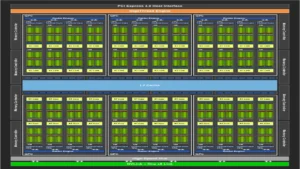
NVIDIA AI Graphics Architecture
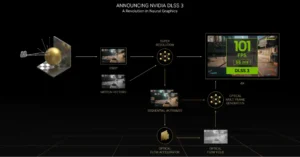
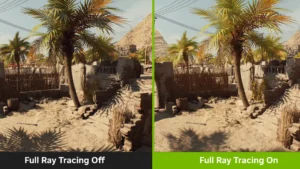
Ray Tracing: Simulating Light Like the Real World
Ray tracing models how light behaves:
- reflections
- refractions
- global illumination
- soft shadows
Instead of faking lighting, it simulates reality.
But ray tracing is computationally expensive.
Real-time ray tracing was impossible on consumer hardware — until NVIDIA built:
- RT Cores
- AI acceleration pipelines
AI denoising models now:
- clean noisy ray-traced frames
- reduce required ray samples
- make real-time ray tracing viable
This combination defines a landmark ai case study in hardware-software co-design.
Ray Tracing in Action
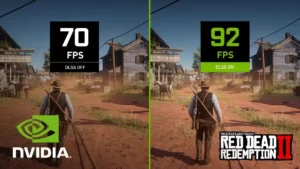
DLSS: Letting AI Invent the Missing Pixels
DLSS changes the entire rendering philosophy.
Instead of rendering at full resolution:
- the game renders fewer pixels
- AI reconstructs the final image
- neural networks predict detail
DLSS uses:
- motion vectors
- depth data
- previous frames
- trained super-resolution models
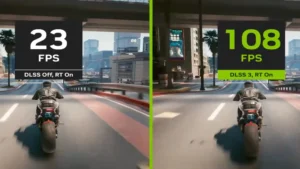
The AI generates a higher-resolution image than what the GPU actually rendered.
The result:
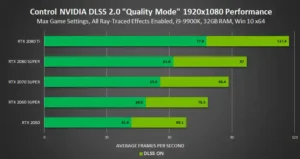
- higher frame rates
- lower GPU load
- better visual quality
DLSS is not upscaling.
It is AI-driven image synthesis — a defining ai case study in real-time generative graphics.
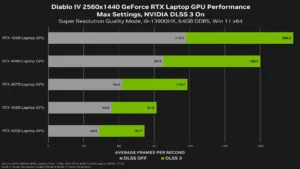
Image Group: DLSS Performance vs Quality

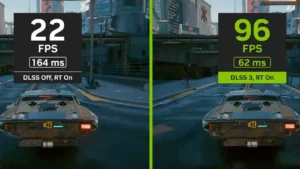
Why This AI Case Study Is Different
Most ai case studies optimize data pipelines or business processes.
NVIDIA’s work:
- rewrites the laws of rendering
- merges hardware with machine learning
- embeds AI directly into silicon
- changes how artists design worlds
Games are no longer just rendered.
They are co-created by neural networks.
This makes NVIDIA’s approach one of the most foundational artificial intelligence case studies in modern computing.
Measured Impact on Gaming
Performance
- higher FPS
- stable frame pacing
- better hardware efficiency
Visual Quality
- realistic reflections
- dynamic global illumination
- film-grade lighting
Developer Freedom
- larger worlds
- richer environments
- fewer technical compromises
This elevates NVIDIA to the center of the modern ai case study ecosystem in creative industries.
Beyond Games: The Ripple Effect
The same AI graphics stack powers:
- virtual production
- film rendering
- architectural visualization
- robotics simulation
- digital twins
- metaverse platforms
Gaming became the proving ground for AI graphics.
Now every 3D industry benefits.
Challenges & Limitations
No real-world ai case study is without trade-offs.
1. Hardware Dependency
AI graphics require modern GPUs.
2. Developer Integration
Games must be engineered for DLSS and RTX.
3. Perceptual Artifacts
AI reconstruction can introduce errors.
4. Trust in Synthetic Detail
Pixels are now predicted, not computed.
NVIDIA mitigates this with:
- continuous model training
- per-game tuning
- fallback rendering paths
What This AI Case Study Teaches Other Industries
This ai case study extends beyond gaming.
Applicable domains include:
- film production
- virtual reality
- simulation training
- industrial design
- digital manufacturing
- platforms studied in ai education case studies
Core lessons:
- AI can replace brute-force computation
- Prediction beats raw processing
- Hardware and AI must co-evolve
- Creative tools benefit from intelligence
- Performance and quality are not opposites
Final Thought
NVIDIA’s graphics revolution proves something fundamental.
AI is not just for data.
In this artificial intelligence case study, AI becomes:
- a renderer
- a light simulator
- a pixel artist
- a co-creator of worlds
By letting neural networks draw reality in real time, NVIDIA shows what the future of creativity looks like — intelligent, immersive, and limitless.
Future of AI-Driven Gaming Worlds

Internal Link Suggestions
- [Internal Link: “Read our breakdown of AlphaFold — AI’s biggest science breakthrough.”]
External Links
- [External Link: “deep 6 AI”]