Robotics are no longer limited to factories performing repetitive tasks. Today’s robots can see, listen, learn, decide, and adapt. This transformation is powered by Artificial Intelligence (AI).
But how are these smart machines actually built?
What technologies turn metal, motors, and code into something that feels intelligent?
Let’s break it down step by step.
1. What Makes a Robot “Smart”?
A traditional robot follows fixed instructions:
If this happens → do that.
A smart robot goes further:
- It understands its environment
- It learns from experience
- It adapts to new situations
This intelligence comes from AI working together with robotics hardware.
Smart robotics combine:
- Physical body (robotics)
- Brain (AI models)
- Senses (sensors)
- Muscles (motors and actuators)

2. The Physical Body: Robotics Hardware
Every robot starts with hardware.
Core components:
- Frame & structure – gives shape and stability
- Motors & actuators – enable movement
- Power system – batteries or wired power
- Control boards – connect hardware to software
Without reliable hardware, even the best AI is useless.
This layer defines:
- How fast a robot moves
- How strong it is
- Where it can operate (factory, home, outdoors)
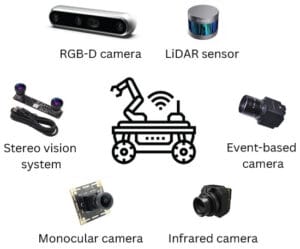
3. Sensors: How Robots Perceive the World
Sensors act as a robot’s eyes, ears, and skin.
Common sensors:
- Cameras (vision)
- Microphones (sound)
- LiDAR & radar (distance and depth)
- Touch and pressure sensors
- Temperature and motion sensors
Sensors convert the physical world into data.
AI does not see objects — it sees numbers generated by sensors. Robotics.
4. Perception: Turning Sensor Data into Understanding
Raw sensor data is meaningless unless interpreted.
This is where AI comes in.
AI perception systems enable robots to:
- Recognize objects
- Detect faces and gestures
- Understand speech
- Map surroundings
- Track movement
For example:
- A robot vacuum identifies obstacles
- A delivery robot detects roads and people
- A medical robot recognizes human anatomy
Perception is the foundation of intelligent behavior.
5. Decision-Making: The Robot’s Brain
Once a robot understands its environment, it must decide what to do next.
AI decision systems handle:
- Path planning
- Task prioritization
- Obstacle avoidance
- Human interaction
This layer answers questions like:
- Where should I move?
- What action is safest?
- How do I complete this task efficiently?
Modern robots don’t rely on hard-coded rules.
They use learning-based decision models that improve over time. Robotics.
6. Machine Learning: How Robots Learn
Learning allows robots to:
- Improve performance
- Adapt to new environments
- Reduce errors
Ways robots learn:
- From human demonstrations
- From simulations
- From trial and error
- From large datasets
This is why robots today are becoming:
- More flexible
- Less dependent on manual programming
- More useful in unpredictable environments
7. Control Systems: From Decisions to Movement
Decisions are useless unless executed precisely.
Control systems translate AI decisions into:
- Motor movements
- Speed adjustments
- Balance control
This layer ensures:
- Smooth motion
- Stability
- Accuracy
For example:
- A robotic arm placing fragile objects
- A humanoid robot maintaining balance
- A drone adjusting to wind conditions
8. Cloud, Edge, and On-Device AI
Robots don’t always think in one place.
Intelligence can run:
- On-device (edge AI) – fast, real-time responses
- On local servers – factory or lab environments
- In the cloud – heavy computation and updates
Modern robots often use a hybrid approach:
- Quick decisions locally
- Complex learning and updates via cloud
This makes robots both responsive and scalable. Robotics.

9. Safety, Ethics, and Human Interaction
As robots work closer to humans, safety becomes critical.
AI systems are designed to:
- Detect humans nearby
- Avoid dangerous movements
- Follow ethical constraints
- Respect privacy and security
Smart robots must be:
- Predictable
- Transparent
- Trustworthy
Without this layer, advanced robotics becomes risky.
10. Where Smart Robots Are Already Being Used
Today’s AI-powered robots operate in:
- Manufacturing and warehouses
- Healthcare and surgery
- Agriculture and farming
- Logistics and delivery
- Defense and space exploration
- Homes and personal assistance
What once belonged to science fiction is now part of daily life.
Why Robotics + AI Matters for the Future
Robotics and AI together are reshaping:
- How work is done
- How humans interact with machines
- How societies function
The goal is not to replace humans —
but to extend human capability.
Robots handle:
- Dangerous tasks
- Repetitive work
- Precision-heavy operations
Humans focus on:
- Creativity
- Judgment
- Ethics
- Purpose
Final Thoughts
Smart robots are not built overnight.
They are the result of:
- Engineering
- Data
- AI models
- Human insight
- Continuous learning
Understanding how robots are built helps us:
- Reduce fear
- Make better decisions
- Prepare for an AI-driven future
Robotics and AI are not just technologies —
they are tools shaping the next phase of human civilization.
See more >>> Zara AI breakthrough >>> Netflix AI