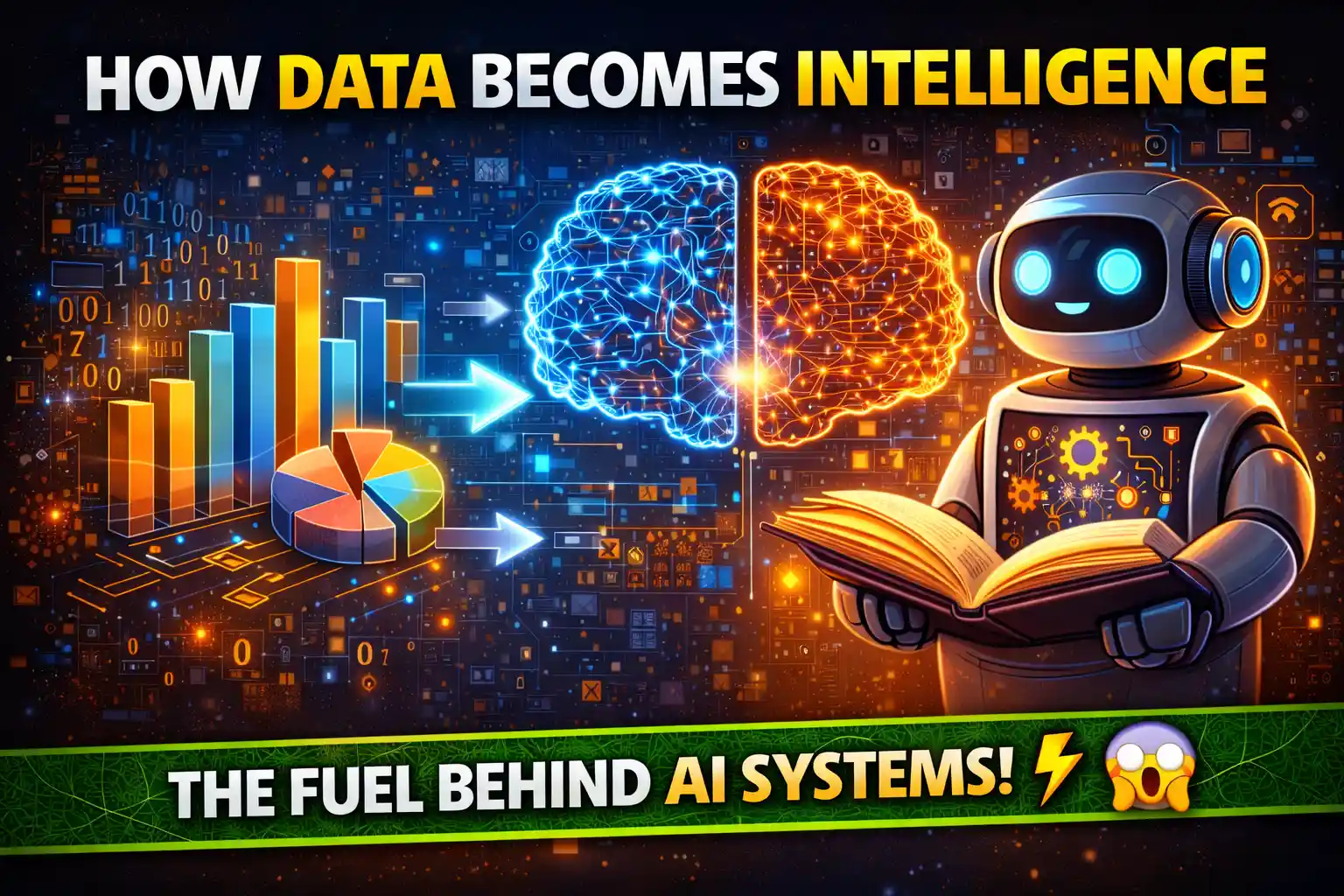
AI Systems: Artificial intelligence often feels mysterious. A machine answers questions, recognizes faces, predicts diseases, drives cars, and writes stories. It looks like “intelligence” has appeared out of nowhere.
But there is no magic inside an AI system.
There is only data.
Every modern AI model—whether it powers search engines, chatbots, recommendation systems, or medical scanners—runs on one core principle: data becomes intelligence. The quality, scale, and structure of data determine how smart an AI system can become.
AI is not born intelligent.
It is trained.
And data is the fuel that shapes its mind. Ai systems.
Data Is Not Knowledge
Humans learn through experience. We touch, feel, observe, fail, and remember. Machines cannot experience the world. They can only observe it through data.
To a computer:
- A photo is a grid of numbers.
- A sentence is a sequence of tokens.
- A transaction is a row in a table.
- A heartbeat is a waveform.
None of this has meaning on its own.
Data becomes useful only when patterns are discovered inside it. Intelligence emerges not from storing information, but from learning relationships:
- Which words tend to follow others.
- Which shapes usually form a face.
- Which behaviors predict a purchase.
- Which signals indicate disease.
AI does not “know” things.
It recognizes statistical structure in data.
That structure is what we call intelligence. Ai systems.
The Transformation Pipeline
Every AI system follows the same journey:
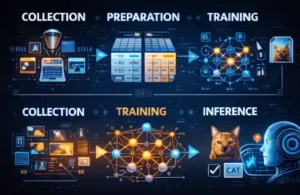
- Raw data is collected.
- Data is cleaned and organized.
- Patterns are learned through training.
- A model is formed.
- The model makes predictions.
- Feedback improves future behavior.
At each step, data changes form.
What begins as noise becomes structure.
What begins as records becomes reasoning.
This transformation is what turns data into intelligence.

Step One: Collection
Data comes from everywhere:
- Cameras
- Sensors
- Logs
- Clicks
- Text
- Audio
- Transactions
- Medical records
A self-driving car gathers video frames and radar signals.
A chatbot learns from books and conversations.
A hospital AI studies scans and reports.
The world is converted into measurable signals.
But raw data is messy. It contains errors, bias, gaps, and contradictions. On its own, it cannot teach anything. Ai systems.
Step Two: Preparation
Before learning begins, data must be made usable.
This stage includes:
- Removing duplicates
- Fixing errors
- Normalizing formats
- Labeling examples
- Filtering noise
For example, an image model may need millions of photos labeled as “cat,” “dog,” or “car.” A language model needs clean text without corruption. A medical system needs accurate diagnoses.
This step is invisible to users, yet it defines success.
Most AI failures come from bad data, not bad algorithms. Ai systems.
Step Three: Learning Patterns
Training is where intelligence begins to form.
The model is shown examples and asked to guess. When it is wrong, it is corrected. Internally, millions or billions of numerical parameters shift slightly.
This process repeats across enormous datasets.
Over time, the system learns:
- How language flows
- What visual features form objects
- Which signals predict outcomes
- How events are related
It does not store facts like a book.
It shapes a probability space.
Every input changes the internal landscape of the model. What emerges is not memory, but generalization—the ability to respond correctly to new, unseen situations.
This is the heart of machine intelligence. Ai systems.
Step Four: Inference
Once trained, the model is deployed.
This is when AI interacts with the real world.
You type a message.
You upload a photo.
You swipe a card.
You drive a car.
The model processes the input and produces a prediction:
- The next word
- The object in an image
- The risk level
- The recommended action
This happens in milliseconds.
What looks like thinking is pattern matching at scale.
The model does not reason.
It estimates.
But when estimation becomes precise enough, it feels intelligent.

Why Data Quality Matters More Than Algorithms
Two AI systems using the same architecture can behave completely differently if trained on different data.
Data determines:
- What the model knows
- What it ignores
- What it amplifies
- What it misunderstands
If data is biased, the AI reflects bias.
If data is incomplete, the AI is blind.
If data is noisy, the AI becomes unstable.
Intelligence is not inside the code.
It is inside the data.
The algorithm is just the engine.
Data is the mind. Ai systems.
Feedback: Intelligence Is Never Finished
AI systems do not stop learning after deployment.
They receive:
- User corrections
- Outcome signals
- Performance metrics
- Environmental changes
These signals feed back into training pipelines. Models are retrained. Parameters adjust. Behavior evolves.
This loop turns static software into adaptive systems.
Intelligence becomes a moving target.
AI is no longer built once.
It is grown continuously. Ai systems.

Why This Changes Everything
When data becomes intelligence, every digital system becomes potentially aware.
Roads become readable.
Cities become observable.
Health becomes measurable.
Markets become predictable.
Language becomes programmable.
Wherever data flows, learning follows.
The world is turning into a training set.
That does not mean AI replaces humans.
It means intelligence becomes embedded in infrastructure.
Decisions that once relied on intuition become data-driven.
Processes that once depended on experience become automated.
Systems that once reacted begin to anticipate.
Final Thought
Artificial intelligence is not about machines becoming human.
It is about data becoming dynamic.
When data is transformed into models that predict, adapt, and respond, it crosses a threshold. It stops being information.
It becomes intelligence.
And in a world where every action creates data,
every system becomes teachable,
and every environment becomes programmable,
the fuel of the future is not oil.
It is data.
See more >>> Zara AI breakthrough