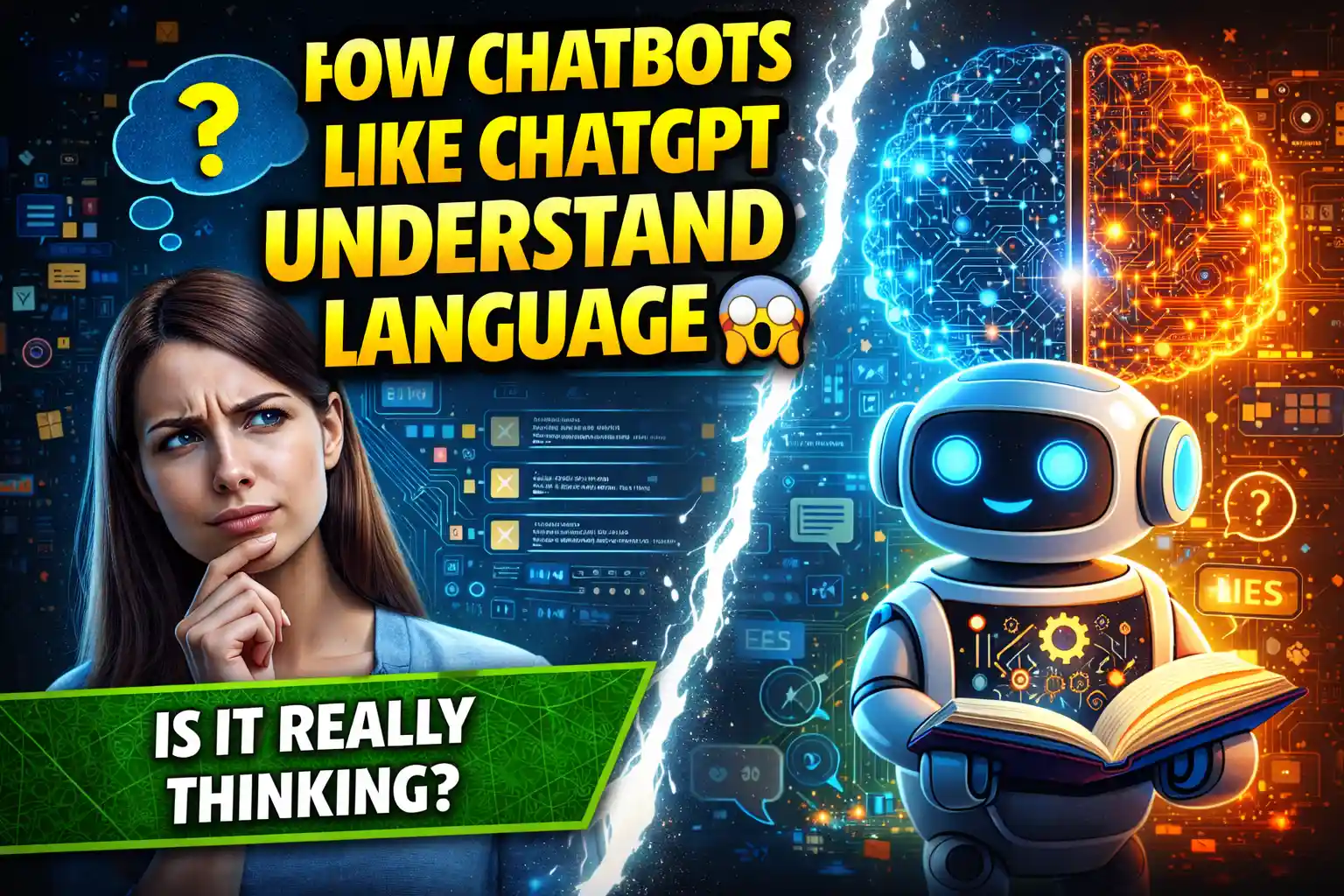
How chatbots work: How ChatGPT Understand Human Language. When you talk to a chatbot like ChatGPT, it feels natural. You ask a question in plain English. You get a clear, relevant reply. Sometimes it even feels like the system “understands” you.
But here’s the truth:
Chatbots do not understand language the way humans do.
They don’t know what words mean.
They don’t have emotions, beliefs, or intentions.
They don’t “think” before answering.
What they do is far more mechanical—and far more fascinating.
Chatbots like ChatGPT are built on a type of artificial intelligence called a large language model. These systems are trained on massive amounts of text and learn how language behaves. They don’t learn facts the way students do. They learn patterns. They learn how words tend to follow other words. They learn how questions are usually answered. They learn how conversations flow.
In other words, they learn the shape of language. How chatbots work: How ChatGPT Understand Human Language
Language as Patterns, Not Meaning
Humans understand language through experience. When you hear the word “fire,” you might think of heat, danger, warmth, or cooking. That understanding comes from living in the world.
A chatbot has no such experiences.
Instead, it sees language as numbers. Every word is converted into a mathematical representation. Sentences become long sequences of values. During training, the model is shown billions of examples like:
- “The sky is blue.”
- “Water freezes at zero degrees.”
- “Once upon a time, there was a king.”
From these examples, the model learns probabilities:
- After “The sky is,” the word “blue” is very likely.
- After “Once upon a time,” a story usually begins.
- After a question, an explanation often follows.
So when you type something, the model does not ask, What does this mean?
It asks, Based on everything I’ve seen, what is the most likely next word?
It generates one word. Then it uses that word as context to generate the next. And then the next. This continues until a full response is formed.
To you, it feels like understanding.
To the model, it is prediction. How chatbots work: How ChatGPT Understand Human Language
Training: Teaching a Machine the Shape of Language
Before a chatbot can talk, it must be trained.
During training, the model is fed huge volumes of text: books, articles, conversations, code, essays, and more. It is given partial sentences and asked to guess what comes next. When it guesses wrong, the system adjusts millions or billions of internal parameters.
This happens over and over, across trillions of words.
Slowly, the model learns:
- Grammar
- Style
- Tone
- Facts that appear frequently
- How explanations are structured
- How arguments are formed
- How stories flow
It does not store these as rules like “a sentence must have a subject.”
Instead, it develops a complex web of statistical relationships.
By the end of training, the model has never understood a single sentence.
But it has become incredibly good at continuing any sentence in a way that feels human.
That is why it can:
- Answer questions
- Write essays
- Summarize text
- Translate languages
- Generate stories
- Explain concepts
All from the same mechanism: predicting the next token. How chatbots work: How ChatGPT Understand Human Language
Context: How ChatGPT Follows Conversations
One reason chatbots feel intelligent is their ability to remember what you just said.
When you send a message, the system doesn’t treat it in isolation. It processes your entire recent conversation as a single block of text. Your previous messages become part of the input.
So if you say:
“Explain gravity in simple terms.”
And then you follow up with:
“Now explain it for a five-year-old.”
The model doesn’t “remember” in a human sense. It simply sees both messages together and predicts a continuation that fits the whole context.
This is why chatbots can:
- Refer back to earlier points
- Maintain a topic
- Adjust tone based on your style
- Appear consistent
It’s not memory in the human sense.
It’s pattern continuation across a longer piece of text.
Why Chatbots Sometimes Sound Confident but Are Wrong
Because chatbots operate on probability, not truth, they can be wrong while sounding certain.
They are trained to produce plausible language, not verified language.
If the training data often contained confident explanations, the model learns to speak confidently. If it has seen many examples where a question is followed by a clear answer, it learns to always provide one—even when the real-world answer is uncertain. How chatbots work: How ChatGPT Understand Human Language
This leads to a strange effect:
- The model can sound like an expert
- It can structure arguments beautifully
- It can explain complex ideas fluently
- And still be incorrect
This happens because the system is optimizing for language quality, not truth.
That’s why human oversight matters. Chatbots are tools for generating and shaping language, not sources of guaranteed accuracy.

What “Understanding” Really Means for AI
When people say, “ChatGPT understands me,” what they really mean is:
“It responds in a way that fits my language and intent.”
From a human perspective, that feels like understanding.
From a technical perspective, it is:
- Pattern recognition
- Probability calculation
- Sequence generation
There is no internal concept of:
- Meaning
- Emotion
- Intention
- Awareness
The model does not know what a dog is.
It knows how the word “dog” behaves in text.
It does not feel empathy.
It knows how empathetic language is written.
And yet, because language itself carries so much human structure, the result feels alive.
That is the power of large language models. How chatbots work: How ChatGPT Understand Human Language
Why This Matters
Understanding how chatbots work changes how you use them.
You stop asking:
“Is the AI thinking?”
And start asking:
“What patterns is it using?”
You realize:
- AI reflects its training data
- AI amplifies common ideas
- AI can inherit bias
- AI can hallucinate
- AI improves with feedback
Chatbots are mirrors of human language at scale. They don’t replace thinking. They shape how ideas are expressed.
They are not minds.
They are engines of possibility in text. How chatbots work: How ChatGPT Understand Human Language
Final Thought
Chatbots like ChatGPT do not understand human language the way you do.
They do not attach meaning to words.
They do not experience the world.
They do not form beliefs.
They observe how language behaves.
They learn how humans write, argue, explain, joke, and imagine.
And they become extraordinarily good at continuing those patterns.
What feels like understanding is actually prediction.
But when prediction becomes this accurate,
when it adapts to your tone, your questions, and your goals,
it begins to feel like conversation.
Not because the machine is human.
But because language itself carries the shape of being human. How chatbots work: How ChatGPT Understand Human Language
See more >>> Zara AI breakthrough