The Silent Revolution: Why Every Enterprise Is Suddenly Talking About Voice
For the past decade, “AI” in the enterprise has largely been a silent partner, working in the background to analyze data, optimize supply chains, and find patterns.1 But since 2024, the focus has pivoted decisively from AI analysis to AI interaction. The fundamental interface between humans and computers is changing. After decades of being dominated by screens and text, the primary interface is rapidly becoming seamless, human-like conversation.2
This is not a gradual trend. It is an inflection point, and the market data is stark. Gartner has released a “big three” set of predictions that, taken together, form an urgent mandate for C-level executives.
- The Multimodal Wave: Gartner predicts that 80% of enterprise software will be multimodal by 2030, surging from less than 10% in 2024.3 A multimodal application is one that can understand and respond using multiple types of data, such as text, images, and, crucially, voice.
- The Rise of the Agent: Even more immediate, Gartner forecasts that 40% of enterprise applications will feature task-specific AI agents by the end of 2026, a massive leap from less than 5% in 2025.4 These “agents” are not just passive chatbots; they are autonomous or semi-autonomous systems designed to execute complex tasks, like orchestrating customer service workflows or managing sales processes.5
- The Critical Window: Most urgently, Gartner warns that C-level executives have a “crucial three- to six-month window” to define their agentic AI product strategy, or they risk being permanently outpaced by the competition.4
These two trends—multimodal apps and autonomous agents—are inextricably linked by a single, non-negotiable requirement: a voice. Not the robotic, disjointed voice of a 1990s-era IVR system2, but a voice that is indistinguishable from a human, capable of conveying emotion, nuance, and brand identity.
The sudden explosion of generative and agentic AI6 has, in turn, created a massive and immediate demand for high-quality, scalable, and secure voice technology. This is the new, non-negotiable front door for the modern business. The business case for this technology is no longer about a simple “text-to-speech” (TTS) feature; it’s about securing the primary voice interface for the coming agentic AI revolution. This strategic shift is what positions a company like ElevenLabs, which has grown from a popular creator’s tool to a critical enterprise solution provider, at the center of this new market.7
Part 1: Defining “Enterprise-Grade”: What Separates a Business Tool from a Toy
For enterprise leaders, the rise of new AI vendors is a source of both opportunity and skepticism.8 Procurement leaders are wary of the “startup pitch”. They are inundated with tools that promise innovation but often lack the integration, security, and support needed for mission-critical operations. Many “ignore most startup pitches,” preferring to wait for their established partners to catch up.8 An “Enterprise-Grade” offering is the direct answer to this skepticism. It signals that the product is not just a feature but a robust, defensible platform.9 In the case of voice AI, this distinction is not about the quality of the voice alone—that is merely the “ticket to the game.” The true differentiator is the framework of security, compliance, and scalability built around the voice. This is what an enterprise is actually buying.
Pillar 1: Security & Compliance (The Non-Negotiable Foundation)
Before any discussion of features or ROI, a tool must pass the security and compliance review. This is where most AI startups fail. ElevenLabs has built its enterprise offering around this principle.
- Core Certifications: The platform maintains SOC2 certification10 and is designed for GDPR compliance.10 For most enterprise SaaS procurement, SOC2 is a non-negotiable baseline.
- The Healthcare & Finance Unlock (HIPAA): The most significant differentiator is the platform’s readiness for high-trust, regulated industries. ElevenLabs offers Business Associate Agreements (BAAs) for HIPAA customers.12 This is a legal framework that makes it possible for healthcare providers, insurers, and their partners to use the platform for applications handling Protected Health Information (PHI).
- The Technical Enabler (“Zero Retention Mode”): The BAA is backed by a critical technical feature: Zero Retention Mode (ZRM). When enabled, this policy ensures that raw audio files and transcripts containing sensitive PHI are not retained by the system.13 This data-handling policy is often the only way a risk-averse CISO or legal counsel can approve the technology.
- Granular Controls: Beyond certifications, the enterprise platform provides fine-grained controls, such as “Tool approval modes” for API usage14, secure credential storage14, and the ability to enforce resource-level permissions, ensuring specific users can only access specific voices.15
Pillar 2: Performance & Scalability (The Engine)
Once security is proven, the tool must perform at enterprise scale. The enterprise product is an API-first solution, designed to be the “voice layer” that integrates into other applications.9 This requires a sophisticated understanding of the trade-off between speed and quality.
A conversational agent in a call center must have low latency to feel human; a 3-second delay is a critical failure. Conversely, an audiobook must have the highest emotional fidelity, and latency is irrelevant.
ElevenLabs addresses this by offering a suite of models for specific use cases17:
- For Real-Time Conversation: The Flash v2.5 model is optimized for speed, delivering latency as low as approximately 75ms, making it ideal for AI agents.17
- For High-Quality Content: The Multilingual v2 model is the choice for rich, emotional expression, perfect for audiobooks, narration, and media.17
- For Balanced Needs: The Turbo v2.5 model offers a middle ground, balancing quality and speed.17 Enterprise plans unlock the technical specifications developers need, including high-fidelity 44.1kHz PCM audio output12, elevated concurrency limits for handling high call volumes12, and a pricing structure that scales. At ultra-high volumes, costs can drop to as low as $15 per million characters.18
Pillar 3: Collaboration & Support (The Safety Net)
An enterprise cannot run a critical customer-facing function on a standard “support@…” email. The platform must support the way large teams work.
- Team Features: The Scale and Business plans introduce multi-seat workspaces for project collaboration.12
- The Support Ladder: This is a key upsell path and a critical enterprise feature. While Pro and Scale plans get “priority support”20, the true Enterprise plan offers dedicated account management, custom terms, and Service Level Agreements (SLAs).11 An SLA is a contractual guarantee of uptime and support response times—another non-negotiable for any mission-critical system.
The core AI models are available to both creators and enterprise clients.17 The real enterprise product—and the justification for its price point—is this “compliance wrapper.” The enterprise isn’t just buying a voice; it’s buying SOC2 compliance, HIPAA readiness, guaranteed uptime via SLAs, and a dedicated support structure.
| Feature | Creator/Pro Plans (Starter, Pro) | Enterprise Plans (Business, Custom) |
| Core AI Models (e.g., Multilingual v2) | ✔ | ✔ |
| Instant Voice Cloning | ✔19 | ✔12 |
| Commercial License | ✔19 | ✔12 |
| SOC2 / GDPR Compliance | ✔ (Public docs)11 | ✔ (Private docs, review)11 |
| HIPAA / BAA Available | ✖ | ✔12 |
| Zero Retention Mode (ZRM) | ✖ | ✔12 |
| Multi-seat Workspaces | ✖ (Starts at Scale)19 | ✔12 |
| Custom SLAs & DPA | ✖ | ✔12 |
| Dedicated Support / Acct. Mgmt. | ✖ (Priority only)20 | ✔12 |
| Custom SSO | ✖ | ✔12 |

Part 2: The Quantifiable Business Case: A Practical ROI Analysis
Once a platform is deemed secure and scalable, the business case shifts to the financial return. The Return on Investment (ROI) for enterprise-grade voice AI is not one-sided. It is a powerful “defense and offense” strategy:
- Defense (Cost Reduction): Reducing operational costs, primarily in customer service and content production.
- Offense (Revenue & Growth): Increasing customer satisfaction, conversion rates, and enabling new products.
The General Market ROI
Industry-wide benchmarks show a clear and compelling financial case for adopting high-quality voice AI.
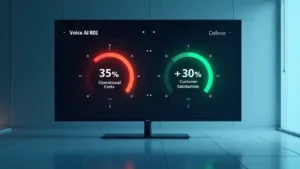
- Operational Cost: Companies that deploy AI-powered customer service report a 20-30% reduction in operational costs. Some white papers cite improvements as high as 40%.
- Call Center Efficiency: A large telecom company cut call handling time by 35%. This is achieved by reducing queue times by up to 50% and average wait times by 80%.
- Customer Satisfaction: This efficiency does not come at the cost of experience. The same study that found a 35% reduction in handling time also saw a 30% rise in customer satisfaction. This is because 89% of customers report a preference for brands that offer advanced voice AI support.
- Sales Conversion: On the “offense” side, companies using branded, high-quality AI voice for outbound B2B calls have seen 35% increases in conversion rates.
- Gauge 1: “Operational Cost” (Arrow pointing to -40%)
- Gauge 2: “Call Handling Time” (Arrow pointing to -35%)
- Gauge 3: “Customer Satisfaction” (Arrow pointing to +30%)
- Gauge 4: “B2B Conversion Rate” (Arrow pointing to +35%)
The ElevenLabs Proof Points
These general market statistics are validated by specific ElevenLabs enterprise customers. The business case can be tailored to the buyer: the COO will respond to the “Defense” case (cost-cutting), while the CMO and Head of Product will respond to the “Offense” case (growth and strategy).
Use Case 1: The AI-Powered Contact Center (Client: Convin)
- The Result: Convin used ElevenLabs-powered AI Agents and saw a 27% increase in their Customer Satisfaction (CSAT) score.
- The Analysis (The “Offense” Case): This is a direct, quantifiable lift in a core growth metric. It proves that a realistic, low-latency AI voice does not alienate customers—it improves their experience. This directly counters the primary fear of automating customer-facing interactions.
Use Case 2: Global Media & Publishing (Client: Gaia)
- The Result: Gaia reduced its dubbing time by 25% and its costs by 10%.
- The Analysis (The “Defense” Case): This is a classic COO-focused ROI. For any global media company, localization is a massive, expensive, and time-consuming bottleneck. ElevenLabs’ multilingual capabilities directly attack this P&L item, collapsing a multi-week production timeline into days.
Use Case 3: The Next-Gen AI Assistant (Client: Perplexity)
- The Result: Perplexity, a leader in the AI search space, launched its flagship AI voice assistant using ElevenLabs.
- The Analysis (The “Strategy” Case): This ROI is the most profound. It’s not about cutting costs or incrementally improving a metric; it’s about enabling an entirely new, mission-critical product. Perplexity chose ElevenLabs to be its brand voice. The value here is not in efficiency, but in “future-proofing” and defining the very nature of the product.
This value extends to internal-facing applications as well. With 80% of employees stating that AI has already improved their work quality and studies showing savings of 7.5 hours per week per employee , the business case is comprehensive.
Part 3: Strategic Analysis: ElevenLabs’ Position in a Crowded Market
For a decision-maker, “Is it good?” is only half the question. The other half is, “Is it better than the alternatives?” The voice AI market is a “three-way race” between distinct categories of vendors. ElevenLabs’ core advantage, which first captured the market’s attention, is its sheer quality. A common refrain online is simply, “How is it so good?”. The models produce voices that are not just clear, but emotionally expressive and human-like.
But for an enterprise, quality must be analyzed in a competitive context.
Race 1: ElevenLabs vs. The Hyperscalers (Google, Amazon, Microsoft)
- The Competitors: Google WaveNet , Amazon Polly , and Microsoft Azure TTS.
- The Hyperscaler Value Prop: Their primary advantage is convenience. They are “good enough” and are already integrated into an enterprise’s existing cloud stack (AWS, GCP, Azure). For a non-critical internal tool, it’s the path of least resistance.
- ElevenLabs’ Advantage: Superior quality and brand identity. In side-by-side comparisons, the hyperscalers’ voices are consistently described as more “robotic”. They lack the emotional range and human-like intonation that ElevenLabs was built for. Furthermore, ElevenLabs offers far more powerful and accessible voice cloning. For a brand-defining AI assistant like Perplexity’s, “good enough” is a death sentence.
Verdict: Hyperscalers win on convenience. ElevenLabs wins on quality, emotion, and brand identity.
Race 2: ElevenLabs vs. The Specialists (WellSaid Labs, Descript, etc.)
- The Competitors: This category includes other focused voice AI companies, most notably WellSaid Labs and platform-studios like Descript.
- The Specialist Battle (Head-to-Head vs. WellSaid): This is the most direct comparison. The analysis is nuanced. Some reviews note that WellSaid Labs offers exceptionally consistent, “studio-quality” professional narration.
- ElevenLabs’ Advantage: Where WellSaid focuses on being a simple studio, ElevenLabs wins on three critical enterprise-platform vectors:
- Flexibility & Control: ElevenLabs is built API-first, with a “robust set of customization options” for pitch, tone, and speed. WellSaid is a simpler, more “locked-in” UI.
- Voice Cloning: This is a killer feature. ElevenLabs excels at it. WellSaid Labs does not offer this functionality.
- Scale & Variety: ElevenLabs has a massive library of over 1200 voices in 29 languages, built for global scale. WellSaid’s library is smaller, with over 500 voices.
Verdict: WellSaid Labs is a strong competitor for static, professional narration (e.g., e-learning modules, corporate training). ElevenLabs is the superior platform for building dynamic, scalable, customizable, and brand-specific voice applications (e.g., agents, API-driven content, and cloned voices).
This competitive landscape reveals ElevenLabs’ true strategy. It is not trying to be a full-stack conversational AI platform that manages the entire customer interaction. This is a critical and deliberate choice. By not competing with the agent-builders (like those in the Gartner Magic Quadrant ), and instead positioning itself as a partner, ElevenLabs can become the default, best-in-class voice provider for all of them. The Perplexity partnership is the blueprint. ElevenLabs is not building the agent; it is giving the agent its voice. This is a far more scalable and defensible “Intel Inside” platform strategy.

Part 4: The Creator Flywheel: Monetizing Content on YouTube & Instagram
For an enterprise decision-maker, it may seem counter-intuitive to analyze the strategies of “faceless” YouTubers and Instagram creators. But for ElevenLabs, the creator economy is not a distraction—it is its primary marketing and R&D engine.
This “Creator Flywheel” is a core part of its B2B success.
- Massive Brand Pull: By winning the creator market, ElevenLabs establishes itself as the de facto standard for quality. Enterprises (like Perplexity) are drawn to the tool because it’s what all the top creators are using.
- Public R&D: Millions of creators are a/b testing, providing feedback, and pushing the models to their limits at a scale no internal QA team could ever replicate.
- A Perfect B2B Funnel: The creator who starts on a free plan and upgrades to the Starter plan to monetize their channel is on a direct path to becoming a “Pro” or “Scale” plan customer as their media business grows.
There are two primary paths creators use to monetize the platform.
Path 1: Active Content Creation (The “Faceless Channel” Playbook)
This is the most popular method, involving the creation of “faceless” YouTube channels or Instagram Reels. The content is driven by a script and an AI voiceover, set against a backdrop of stock footage, animations, or gameplay.
- The Monetization Rule: This is allowed, but with one critical rule: to monetize content on YouTube, a commercial license is required. This means creators must be on a paid plan (e.g., Starter, Creator). Using the free plan for a monetized channel is a violation that can lead to demonetization.
- The “AI Slop” Caveat: YouTube’s policies are not against AI voice; they are against “mass-produced lazy content”. A channel that uses high-quality, original scripts and thoughtful editing will generally have no issues with monetization.
- The 5-Step Process:
- Find a Niche: Popular faceless niches include true crime narration, deep-dive documentaries, DIY, interesting facts, and book summaries.
- Write the Script: AI tools like ChatGPT are often used to research and write the script.
- Generate the Voiceover: The script is fed into ElevenLabs to generate the audio.
- Find Visuals & Edit: Creators use stock footage (e.g., Pexels), simple graphics (e.g., Canva), and free editing software (e.g., CapCut).
- Monetize: Once the channel meets the YouTube Partner Program (YPP) requirements (1,000 subscribers and 4,000 watch hours), the creator earns ad revenue.
For Instagram Reels, the principle is the same. The platform’s AI dubbing feature is a powerful growth hack, allowing creators to translate and re-record their scripts in multiple languages instantly, tapping into global audiences.
Path 2: Passive Income (The “Voice Library” Playbook)
This is a “sell the pickaxes” model. Instead of making content, the creator licenses their own voice to other creators and earns passive royalties.
- How it Works (The Payouts Program):
- The Plan: The creator needs the Creator plan ($22/month) to access Professional Voice Cloning.
- The Audio: They must record and upload at least 30 minutes of clean, expressive audio (though 2-3 hours is recommended for higher quality).
- The Verification: An on-camera test is required to confirm ownership of the voice.
- Get Paid: The voice is made “Discoverable” in the Voice Library. Every time another user generates audio with that voice, the original creator gets paid by the character.
- Realistic Earnings: This is a viable income stream.
- The Rates: The default rate is ~$0.03 per 1,000 characters. Voices that earn an HQ badge for high quality can charge up to $0.20 per 1,000 characters.
- The Proof: Voice actors have earned a combined $5 million through this program. Real-world examples show its potential: one Reddit user reported $200 in a month from a single upload; a blogger made $1,000 in five months from two voices.
A Critical Pro-Tip: The “Right Way” vs. The “Wrong Way”
The biggest complaint from audiences about AI voice content is that it sounds “lifeless” or lacks emotion. This is what causes viewers to “click away”.
The “Wrong Way”: Simply copy-pasting a script into the text-to-speech generator. The AI is left to guess the tone and pacing, often resulting in a flat delivery.
The “Right Way” (The Power-User Secret): A YouTuber who gained over 10,000 subscribers in 60 days revealed their method.
- First, they record the script in their own voice, with all the natural pauses, energy, and emotion.
- Then, they use the ElevenLabs Voice Changer feature (not the standard TTS) to convert their own recording into a different AI voice.
The result is a “real” human cadence and emotion, delivered with a perfect AI vocal texture. This solves the core “lifeless” problem and is the single best way to create content that truly connects.
- Path A (Active): Script -> ElevenLabs TTS (Commercial Plan) -> Edit Video -> Upload to YouTube (YPP) -> Earn Ad Revenue
- Path B (Passive): Record 30+ Mins of Your Voice -> Clone on Creator Plan -> Publish to Voice Library -> Earn Royalties ($0.03-$0.20 / 1k chars)


Final Verdict: The 2026 Business Imperative
The analysis began with Gartner’s warning: 40% of enterprise apps will have AI agents by 2026 , and 80% will be multimodal by 2030. The “three- to six-month window” to devise a strategy for this new, conversational world is now.
In this new era, a brand’s “voice” is no longer a marketing metaphor. It is becoming a literal, audible, and interactive asset. The choice of which technology will power this asset will define the customer experience for the next decade.
The business case for a platform like ElevenLabs is built on three pillars:
- It is Secure: It has the non-negotiable “compliance wrapper” (SOC2, GDPR, HIPAA, BAAs) that mitigates risk, unblocks procurement, and enables entry into high-value regulated industries.
- It is Performant: It provides the necessary suite of API-driven models, from low-latency (Flash) for real-time agents to high-fidelity (Multilingual v2) for professional media.
- The ROI is Proven: The value is not theoretical. It is delivering quantifiable “Offense” (+27% CSAT for Convin), “Defense” (-25% time-to-market for Gaia), and “Strategy” (enabling Perplexity’s core product).
The decision is no longer if an enterprise will adopt a voice interface, but which one. Choosing a “good enough” solution from a hyperscaler is a short-term convenience that risks long-term brand mediocrity. The analysis shows that ElevenLabs has strategically positioned itself as the “best-in-class” platform leader , balancing a dominant, creator-driven brand with a secure, performant, and high-ROI enterprise product. Adopting this technology is not just an efficiency play; it is a strategic imperative for owning a brand’s identity in the new agentic, conversational era.