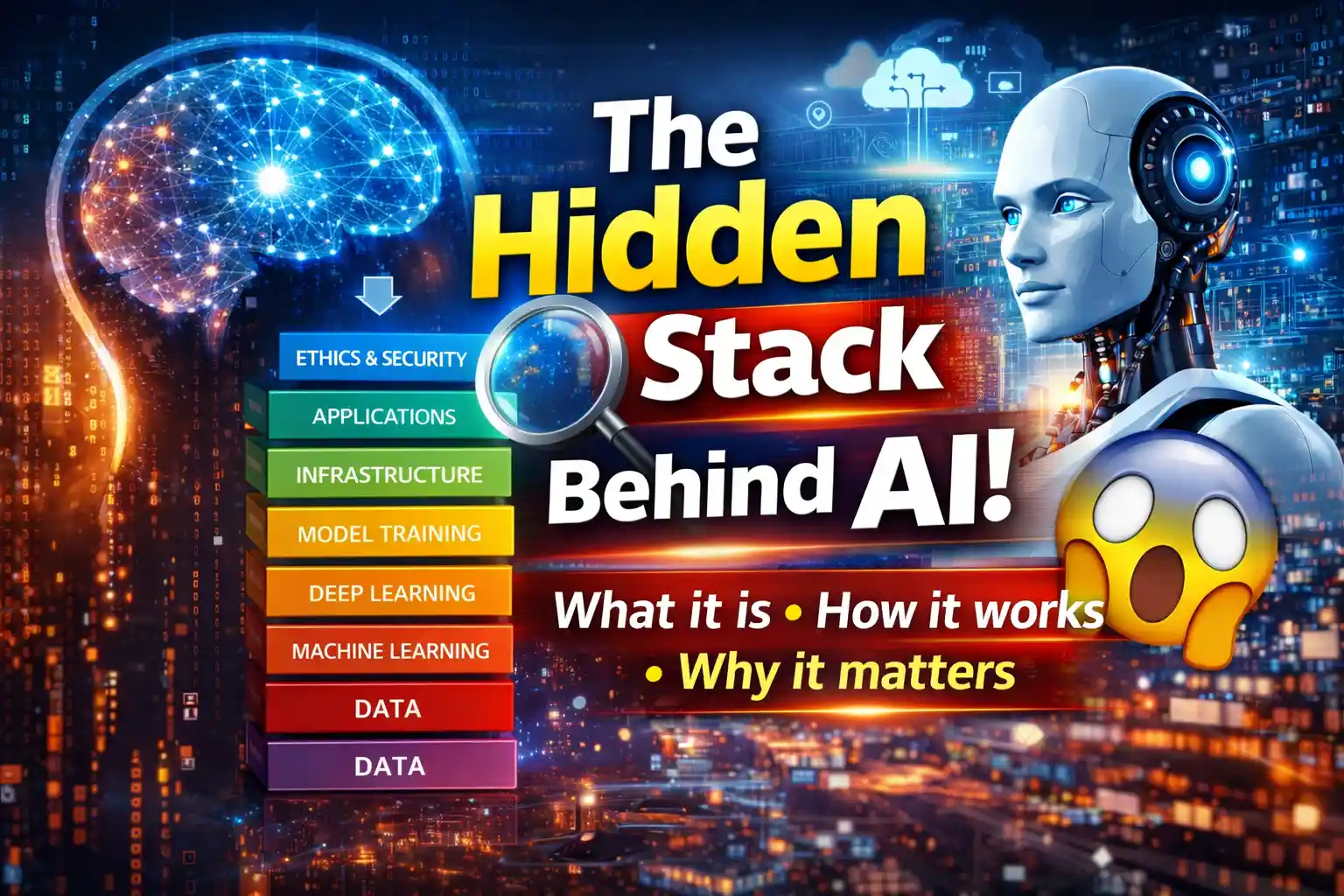
Artificial Intelligence often feels like magic. You type a question, an AI answers. You upload an image, it understands what’s inside. But behind this “magic” is a well-structured technology stack—a layered system of tools, data, models, and infrastructure working together.
Understanding this stack helps individuals, students, and businesses see how AI really works, what powers it, and where the future is heading.
Let’s break it down step by step.
1. Data: The Foundation of All Artificial Intelligence
AI does not think on its own. It learns from data.
Types of data AI uses:
- Text (articles, messages, books)
- Images (photos, medical scans)
- Audio (speech, music)
- Video
- Sensor data (GPS, IoT devices)
Without large and high-quality data, AI systems fail—no matter how advanced the algorithms are.
Key idea:
Better data = better intelligence
This is why companies like Google, Amazon, and Meta invest heavily in data collection and data cleaning.
2. Data Storage & Processing Layer
Raw data is useless unless it is stored and processed efficiently.
Technologies involved:
- Databases (SQL, NoSQL)
- Data warehouses
- Data lakes
- Big data frameworks (for massive datasets)
This layer ensures:
- Data is accessible
- Data is cleaned and structured
- Data can be processed at scale
In real life, this is where AI systems prepare “learning material” before training begins.
3. Machine Learning Frameworks
This is where learning actually happens.
Machine learning frameworks allow developers to:
- Build models
- Train them on data
- Improve accuracy over time
Common capabilities:
- Pattern recognition
- Prediction
- Classification
- Decision-making
This layer turns raw data into intelligence.
Without machine learning frameworks, AI would be just stored data with no understanding.
4. Deep Learning & Neural Networks
Deep learning is a specialized part of machine learning inspired by the human brain.
What it enables:
- Image recognition
- Speech recognition
- Language understanding
- Face detection
- Recommendation systems
Neural networks consist of layers that:
- Take input
- Extract features
- Learn complex relationships
- Produce output
This layer powers of Artificial Intelligence:
- Chatbots
- Voice assistants
- Self-driving features
- Medical image analysis
5. Model Training & Optimization
Training an AI model is computationally expensive.
This layer focuses on:
- Training models faster
- Improving accuracy
- Reducing errors
- Preventing bias
Key elements:
- GPUs and specialized chips
- Parallel computing
- Optimization algorithms
- Model evaluation techniques
This is where AI becomes reliable and usable in real-world scenarios.
6. Cloud & Infrastructure Layer
Modern AI runs on massive infrastructure.
Why cloud is critical:
- Scalability (millions of users)
- Storage for huge datasets
- High-performance computing
- Global access
This layer allows AI systems to:
- Serve real-time responses
- Update continuously
- Handle global traffic
Without cloud infrastructure, AI would remain limited to labs and research papers.

7. APIs & Application Layer
This is the layer people actually interact with.
Examples:
- Chat interfaces
- Mobile apps
- Websites
- Voice assistants
- Recommendation engines
APIs connect AI models to real applications, making intelligence usable for humans.
This is how AI enters:
- Education
- Healthcare
- Business
- Entertainment
- Daily life
8. Monitoring, Ethics & Security Layer
AI systems must be:
- Safe
- Fair
- Transparent
- Secure
This layer focuses on:
- Bias detection
- Model monitoring
- Data privacy
- Security protection
- Responsible AI practices
As AI becomes more powerful, this layer becomes more important than ever.
How the Entire Stack Works Together
Think of the AI technology stack like a human system:
- Data → Experience
- Machine learning → Learning ability
- Neural networks → Brain
- Infrastructure → Body
- Applications → Actions
- Ethics & monitoring → Wisdom and responsibility
Each layer depends on the one below it. If one layer fails, the whole system weakens.
Why This Matters for Individuals
Understanding the AI technology stack helps you:
- Use AI tools wisely
- Choose the right skills to learn
- Avoid misinformation and hype
- Prepare for the AI-driven future
AI is not magic.
It is engineering, data, and human intelligence combined.
Final Thoughts
Artificial Intelligence is not a single technology—it is an ecosystem.
The real power of AI lies not in one model or tool, but in how the entire technology stack works together to transform data into decisions.
Those who understand this stack will not fear AI.
They will shape its future.
See more >>> Zara AI breakthrough >>> Netflix AI