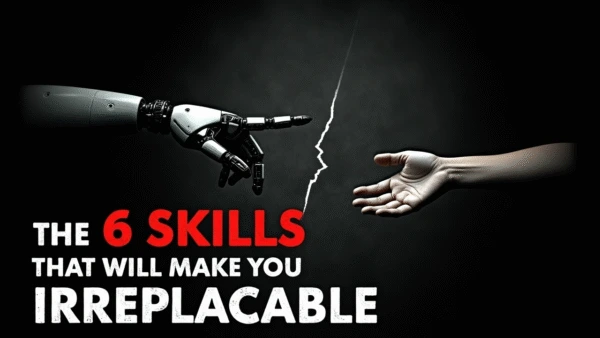
6 Essential Skills You Need to Outsmart AI
The AI Panic vs. The Human Opportunity
Let’s be honest: the rise of AI is both amazing and a little scary. It seems like every week, a new tool can write articles, create stunning art, or analyze data in seconds. It’s easy to look at this and wonder, “Where do I fit in?”
But here’s the secret: AI is a calculator, not a visionary. It’s a powerful tool for computation and pattern recognition, but it lacks the one thing that truly drives progress: humanity. It can’t feel, it can’t dream, it can’t understand why one choice is better than another beyond the data it was fed.
This isn’t a race against the machine. It’s a race to become more human. The future belongs to those who cultivate the skills that AI can’t replicate. This is your guide to doing just that.
AI’s Strengths vs. Your Human Advantage
First, let’s understand the difference in capabilities. AI’s “brain” is built on logic and massive datasets. It excels at tasks that are repetitive, data-heavy, and logical. Think of it as the ultimate assistant for handling the “what.” It can process a million spreadsheets, find a needle in a digital haystack, and automate workflows with perfect precision.
Your brain is built on experience, emotion, and connection. You excel at the “why” and “how.” You can understand the context behind the data, feel empathy for a customer, navigate a complex team dynamic, and make a tough ethical judgment when the “right” answer isn’t in the data.
Visualized: The Human vs. AI Skill Profile
This chart shows the fundamental gap. AI dominates pure computation, but when it comes to the nuanced skills that build businesses and solve complex problems, the human advantage is clear. Your skills are in a different category entirely.

The Future of Work is Human-Centric
While AI will certainly automate many tasks, it won’t automate jobs. Why? Because most jobs are a messy, complex bundle of tasks that require exactly the skills AI lacks. As the chart below suggests, the vast majority of future work will be human-centric—requiring our creativity, judgment, and connection.

The 6 Essential “Human” Skills to Master
These are not just ‘soft skills’; they are your core competitive advantage. Here’s a detailed look at what they are, why they matter, and how to start building them today.
1. Critical Thinking & Complex Problem-Solving
What it is: This is your ability to analyze a situation, ask “why,” challenge assumptions, and connect seemingly unrelated dots. AI can give you a dashboard of data, but it can’t tell you what that data means for your business, your team, or your community. You can.
In Action: An AI can report that “sales are down 15% in the northeast.” A critical thinker asks, “Why? Was it our new competitor? A regional holiday we missed? Did our marketing message fail in that culture?” You solve the real problem, not just the symptom.
How to Develop It: Practice the “Five Whys.” When you have a problem, ask “why” five times in a row to get to the root cause. Read opinions you disagree with and try to honestly understand their logic.
2. Emotional Intelligence (EQ)
What it is: EQ is your ability to understand and manage your own emotions, and just as importantly, to recognize and influence the emotions of others. It’s the core of empathy, persuasion, and teamwork. An AI can mimic polite language, but it can’t feel empathy.
In Action: An AI chatbot can handle a routine customer service query. But an EQ-driven human can listen to a frustrated customer, validate their anger, and turn a negative experience into a loyal relationship. In a team, you can sense when a colleague is burning out and offer support before they quit.
How to Develop It: Practice active listening. In your next conversation, try to only listen without planning your response. Then, summarize what the other person said and ask, “Did I get that right?”
3. Creativity & Innovation
What it is: True creativity isn’t just “art.” It’s the ability to generate new and valuable ideas. AI is a remix engine; it mashes up everything it has been trained on to create something that looks new. But it can’t have a truly original idea. It can’t have a “shower thought.”
In Action: An AI can generate 100 variations of your logo. A creative human can invent a new product category, a new business model, or a new way to tell your company’s story that no one has ever thought of before.
How to Develop It: Expose yourself to different fields. Read a book on biology, watch a documentary on architecture, learn an instrument. Creativity comes from connecting ideas from different domains.
4. Communication & Collaboration
What it is: This is about more than just talking or writing. It’s the ability to take a complex idea and make it simple, persuasive, and clear. It’s the art of building trust and consensus within a group to achieve a common goal. AI can write a report, but it can’t inspire a team.
In Action: An AI can generate the minutes of a meeting. A great collaborator can lead that meeting, making sure everyone feels heard, navigating disagreement, and ending with a clear set of action items that everyone is bought into.
How to Develop It: Join a group like Toastmasters. Volunteer to lead a project. Before you send an important email, read it aloud and ask, “Is this simple? Is this clear? What do I want the reader to do?”
5. Adaptability & Lifelong Learning
What it is: The world is changing faster than ever, and AI is accelerating that change. Adaptability is your willingness to unlearn old ways and embrace new ones. It’s the curiosity to constantly ask, “What’s new?” and “How can I use that?”
In Action: When AI automates part of your job, you have two choices. You can resist, or you can adapt. The adapter says, “Great. Now that the boring part is done, how can I use this tool to analyze the results? How can I level up to become the manager of this AI system?”
How to Develop It: Dedicate 30 minutes every week to learning something new, even if it’s not related to your job. Try a new software, read a technical blog, or take a free online mini-course. Build the habit of learning.
6. Leadership & Ethical Judgment
What it is: This is perhaps the most human skill of all. It’s the ability to make tough calls in “gray areas” where there is no right answer. It’s about having a vision, inspiring others to follow it, and taking responsibility for the outcome. AI has no values. It has no ethics. It only has programming.
In Action: An AI can optimize a factory for 100% efficiency, but it might recommend firing 50% of the workforce. A human leader has to weigh the data against the impact on people, the community, and the company’s long-term reputation.
How to Develop It: Don’t shy away from responsibility. Mentor a junior colleague. When faced with a tough choice, write down the potential consequences for all stakeholders (employees, customers, community), not just the bottom line.
Proof: Employers Are Desperate for These Skills
This isn’t just a theory; it’s what the job market is screaming for. Technical skills have a short shelf-life and can often be automated. But these human skills? They are durable, transferable, and increasingly valuable. This chart shows what companies are actively looking for—and it’s not “AI prompt engineering,” it’s critical thinking.

The Takeaway: Building your technical skills is good. Building your human skills is a long-term career strategy. AI will become a commodity; your judgment, creativity, and leadership will only become more rare and valuable.
Your 4-Step Action Plan to Get Started
1. Identify
Be honest. Of the 6 skills, which is your weakest? Or which one would make the biggest impact on your career right now? Pick just *one* to focus on first.
2. Practice
Seek it out. Volunteer for the project no one wants. Ask to lead a meeting. Find small, daily opportunities to consciously practice that one skill.
3. Get Feedback
This is the accelerator. Ask a mentor or a trusted peer, “I’m working on my communication. How did I do in that presentation? What’s one thing I could do better?”
4. Iterate
Apply the feedback. Try again. You don’t master these skills overnight. You build them, conversation by conversation, project by project. Then, repeat the cycle.
Take the Next Step: Deeper Learning & Resources
Reading this article is a great first step, but real mastery comes from diving deeper and putting these skills into practice. If you’re serious about developing your human edge, I’ve curated a short list of the best books and online courses to help you on your journey.
These are the foundational guides and in-depth university programs that can take you from simply knowing about a skill to truly owning it.
Full disclosure: The links below are affiliate links. If you use them to make a purchase, I may earn a small commission at no extra cost to you. I only recommend resources I truly believe in.
On Critical Thinking & Problem-Solving
On Emotional Intelligence (EQ)
On Creativity & Innovation
On Communication & Collaboration
On Adaptability & Lifelong Learning
On Leadership & Ethical Judgment
Your Humanity is Your Greatest Asset.
Don’t be afraid of AI. Use it. But never, ever stop investing in the skills that make you human. They are your ultimate job security and your key to a successful, fulfilling career in an age of automation.